Friendships Matter
Medical research has documented the dramatic effects of friendship on health, well-being and longevity. Loneliness turns out to be the modern killer disease, outranking and/or exacerbating the usual candidates. Inadequate or poor integration into your social network comes in behind only heart attacks and strokes in lethality. A strong social network increases survivability by 50%, equal to giving up smoking. Besides the usual help, encouragement and enjoyment that friendships bring, research suggests that endorphins released by the presence of friends tunes the immune system to enhance resistance to a variety of ailments.
The Structure of Friendships
You may be familiar with Dunbar's Number. People who study social networks say that the average size of a friendship network (the dividing line between friends and acquaintances) is about 150+/–. This is a natural group size in human communities gleaned from a wide variety of research done across the world. There are small but consistent fluctuations in that number based on personality, sex and age: Younger people tend to have more friends (which some believe is explained by youngers being less discriminating in friend selection.) Extroverts tend to have slightly more friends than introverts (though introverts think that while they have fewer friends, the relationships run deeper.) Women have more friends than men. Night owls tend to have larger social networks than early birds. Within one's social network, usually about 70% are of your own gender. Circles of friendship expand by roughly 3 times at each level of friendship. From Robin Dunbar's excellent book: Friends: Understanding the Power of our Most Important Relationships. 2021. See the Circles graph
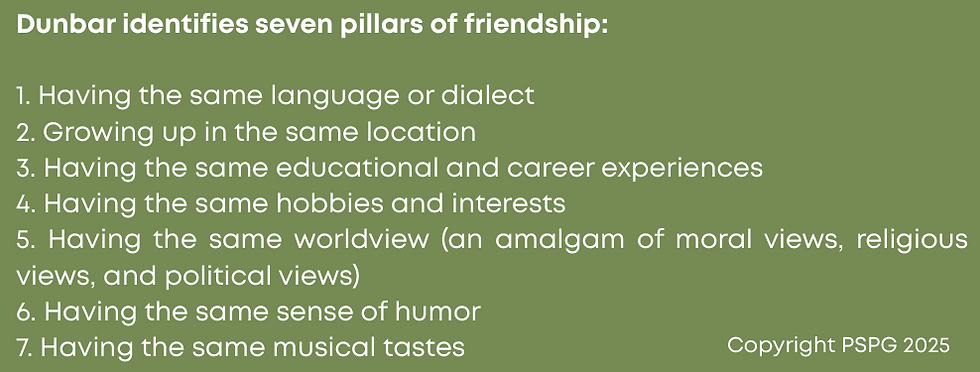

The more of these boxes we have in common with someone, the more times we're prepared to invest in them, the more emotionally close we feel towards them, the closer they will be to us in the layers of our social network, and the more willing we will be to help them out when they need it. And, the more likely they are to help us. Birds of a feather really do flock together. We tend to gravitate towards people with whom we have more things in common.
We tend to like the people more who are more like us. In fact, each layer of your social network is equivalent to a particular number of 'pillars' shared – six or seven for the innermost five person layer, just one or two at the outer 150 person layer. It doesn't seem to matter which ones are actually shared in common, no hierarchy or preference. A three pillar friend is a three pillar friend irrespective of which three pillars are in common. The process of making a new friend follows a fairly set pattern.
When we first meet someone new we invest a fair amount of time in them as we discern (usually at a subconscious level) which pillars we share in common. It takes time but once we have a sense of it, we reduce the time we devote to them to a level appropriate to the number of pillars we have in common. As a result, they quietly slide back down through the layers to settle out in the layer appropriate to the number.
Friendship is a two-way street, requiring both parties to be reasonably accommodating and tolerant of each other...
When friendships end, they typically die in one of two ways – by gradually fading out or by cataclysmic collapse. Old friendships may fade as circumstances change and they are replaced by new friendships, like leaving high school to go to college, moving for job or family, etc. Friendships often die when we don't see the people often enough to maintain the relationship. Cataclysmic endings are often associated with very close relationships, inner circle, romantic partners, etc.

Breaking any of these rules seems to weaken the relationship, and breaking many often leads to complete relationship breakdown
When people describe the causes of a relationship breakdown, the three most frequent causes were: perceived lack of caring, poor communication, and jealousy.
Between them these three seem to account for more than 50% of all cases of relationships breaking down. Breaches of trust figure prominently, the smaller the circle–the higher the level of trust. More trust increases a relationship's resistance to a breach of trust, but bigger or more frequent breaches will destabilize it. The closer the relationship, the more terminal a de friending may be in such cases. Often, family tends to be more forgiving, perhaps because we are stuck with each other through kinship.
There is a noticeable gender difference in relationship breakdowns. Men tend to mention drifting apart, problems with alcohol or drugs, and competition from rivals and others stirring things up. Women are more likely to mention poor communication, jealousy, and tiredness making them less caring (which sounds a lot like burn-out.)
Also noticed is where men tend to blame others, women tend to blame themselves. One of the challenges in very close relationships such as romantic ones, is each gender coming to the relationship with different expectations. There is a perception that women have higher expectations with regard to reciprocity (of loyalty, trustworthiness, mutual regard and support,) genuineness and communion (willingness to engage in self-disclosure and intimacy.) Men, in contrast, seem to have higher expectations in regards to physical activities and striving for status. Stylistically, men seem more confrontational, inclined more to joke at another's expense, and show more attempts to score points over each other in a way perceived by them to be friendly but by women as threatening or even intentionally aggressive. There is speculation these may be more characteristic pre rather than post mid-life crisis.
Close family or romantic relationships are the ones most at risk of ending catastrophically, and are the most difficult to reconcile precisely because they may end with an acrimonious rupture. Rule of thumb is that if a reconciliation is going to happen, it is within the first few weeks after the break-up. Otherwise, it becomes semi-permanent with neither side being prepared to initiate the process of reconciliation.
So, tending your friendship garden is just as important for your physical well being as it is for your emotional health and overall well-being. Water it regularly through mindful connection, attention, curiosity and quality listening. Your life may depend on it.


Comments